Mindful Clarity Printable Journal: Mindfulness, Gratitude & Calm
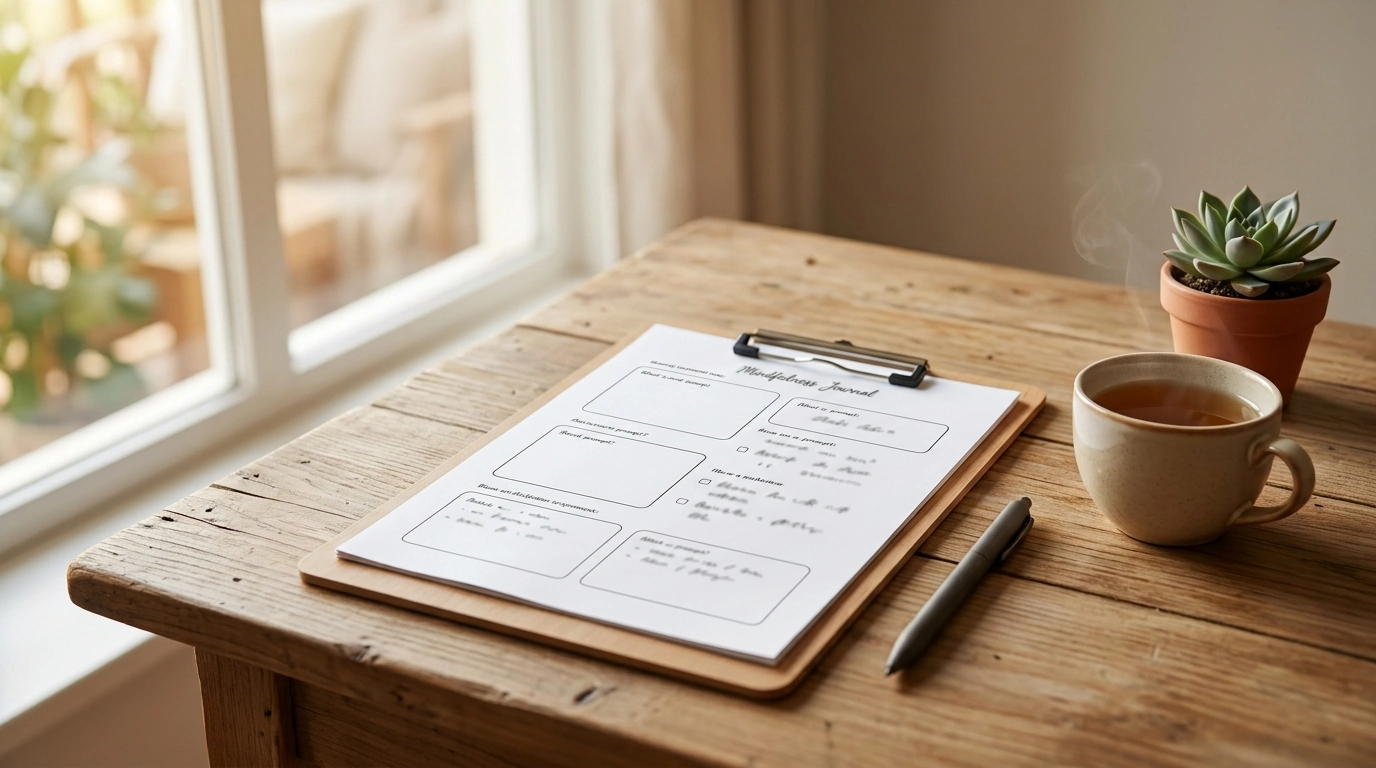
Mindful Clarity: A Printable Journal for Daily Mindfulness, Gratitude, and Reflection
Mindful Clarity is a printable journal designed to support calmer days and clearer thinking through short daily mindfulness check-ins, gratitude exercises, and reflective quotes. It’s structured for consistency without feeling rigid—helpful for building a steady habit that fits into mornings, lunch breaks, or evenings. If you like writing by hand and want a simple way to notice patterns, reset your attention, and leave the day with a clearer mind, this format keeps it approachable.
Mindfulness and gratitude are widely studied skills that can support well-being when practiced consistently. If you’d like background reading, the American Psychological Association overview of mindfulness and UC Berkeley’s Greater Good resources on gratitude offer practical context.
What Mindful Clarity Supports Day to Day
- Creates a small, repeatable pause to notice thoughts, emotions, and body signals before stress builds.
- Encourages balanced self-talk by capturing wins, needs, and next steps in writing.
- Strengthens gratitude as a skill—shifting attention toward what is supportive, stable, or improving.
- Uses reflective quotes as a gentle cue for deeper journaling without needing long writing sessions.
- Works well for personal growth routines, therapy homework, or a simple end-of-day reset.
What’s Inside the Printable Journal
- Daily mindfulness prompts to guide awareness of mood, energy, triggers, and intentions.
- Gratitude exercises that go beyond listing—adding meaning, context, and practical action.
- Reflective quotes paired with space to respond (agreement, resistance, examples, and application).
- A clean printable format that can be used as loose pages, inserted into a binder, or printed as a booklet.
- Flexible pacing: use one page per day, repeat favorite pages, or rotate sections based on need.
To get started, use the Mindful Clarity printable journal as a daily anchor—one page is enough to create a “pause point” that’s easy to return to, even during busy weeks.
A Simple Routine That Makes the Pages Feel Easier
- Option A (Morning, 5 minutes): set an intention, choose one mindful focus (breath, body, or task), and name one supportive action for the day.
- Option B (Midday, 3 minutes): quick check-in—what’s happening internally, what’s needed, and what can be released.
- Option C (Evening, 7 minutes): gratitude reflection + one lesson learned + one kind boundary for tomorrow.
- When motivation is low: write only in bullet points; aim for clarity, not completeness.
- When emotions are intense: start with body sensations and basic needs (rest, food, connection, movement) before problem-solving.
Quick Pick: Which Page Style Fits Today?
| Today feels like… | Best journal focus | One sentence to start with |
|---|---|---|
| Overwhelmed | Grounding + smallest next step | Right now, my body is asking for… |
| Unmotivated | Micro-goal + self-compassion | If this day could be 1% easier, I would… |
| Anxious | Reality check + reassurance | The worry is saying…, and the facts are… |
| Restless | Mindful action + attention training | The one task that deserves my full attention is… |
| Grateful | Savoring + meaning | This mattered to me because… |
| Reflective | Quote response + lesson | This idea challenges me when… |
Gratitude Exercises That Feel Real (Not Forced)
- The “specific moment” method: name one small moment (a text, a meal, a quiet minute) and describe why it counted.
- The “support system” method: identify one person, place, or habit that held you up today—and one way to reinforce it.
- The “growth lens” method: write one thing that was hard and one thing it taught (or is teaching) without minimizing the difficulty.
- The “future gratitude” method: write tomorrow’s gratitude in advance—what would make the day feel steadier, and what choice supports that outcome?
- If gratitude feels inaccessible: start with neutral stability (e.g., “I had clean water,” “I had a place to sit”) and build from there.
When gratitude feels performative, the fix is usually specificity. Instead of “I’m grateful for my friends,” try one concrete detail: “I’m grateful Alex checked on me, because it helped me feel less alone—and I want to return that care tomorrow.”
Reflective Quotes: How to Use Them Without Overthinking
- Read once and underline a single phrase that stands out—skip interpreting the entire quote.
- Respond with one of three angles: “This is true when…”, “This is hard because…”, or “I can try this by…”.
- Use quotes as a reframe tool: translate the quote into practical behavior for the next 24 hours.
- When stuck, write a short counterpoint—what part of the quote feels unrealistic today, and what would feel more believable?
- Close with a grounding line: one kind statement to yourself that doesn’t require perfection.
This approach keeps the quote section from turning into a “right answer” exercise. The goal is gentle honesty—enough reflection to learn something, not so much that you spiral.
Printing and Setup Tips for a Smooth Habit
Who This Works Well For
Helpful Add-Ons for a Stronger Daily Practice
- Memory Boost Worksheets for Students & Adults for structured recall tools, study support, and brain-training exercises when focus feels scattered.
- Critical Thinking & Problem Solving eBook for decision-making frameworks that pair well with journaling insights (turn reflections into practical next steps).
FAQ
What are some good daily journal prompts for reflecting on my mental health?
Try rotating short prompts like: “What emotion is most present right now?”, “Where do I feel stress in my body?”, “What triggered me today (and what did it remind me of)?”, “What do I need more of this week?”, “What boundary would protect my energy tomorrow?”, “What did I do well even if it was small?”, “What story am I telling myself—and what’s a kinder version?”, “What’s one step I can take in the next 10 minutes?”, “Who or what supported me today?”, and “What can I let be ‘good enough’ right now?”
How long should a daily mindfulness journaling session take?
Most people do well with 3–10 minutes. On busy days, choose just one section (check-in, gratitude, or a quote response) and write in bullets—consistency matters more than length.











Leave a comment